
The Human Nervous System: A Clear Guide to How Your Body Senses, Thinks and Moves
In this article · 4 sections
What is the nervous system?
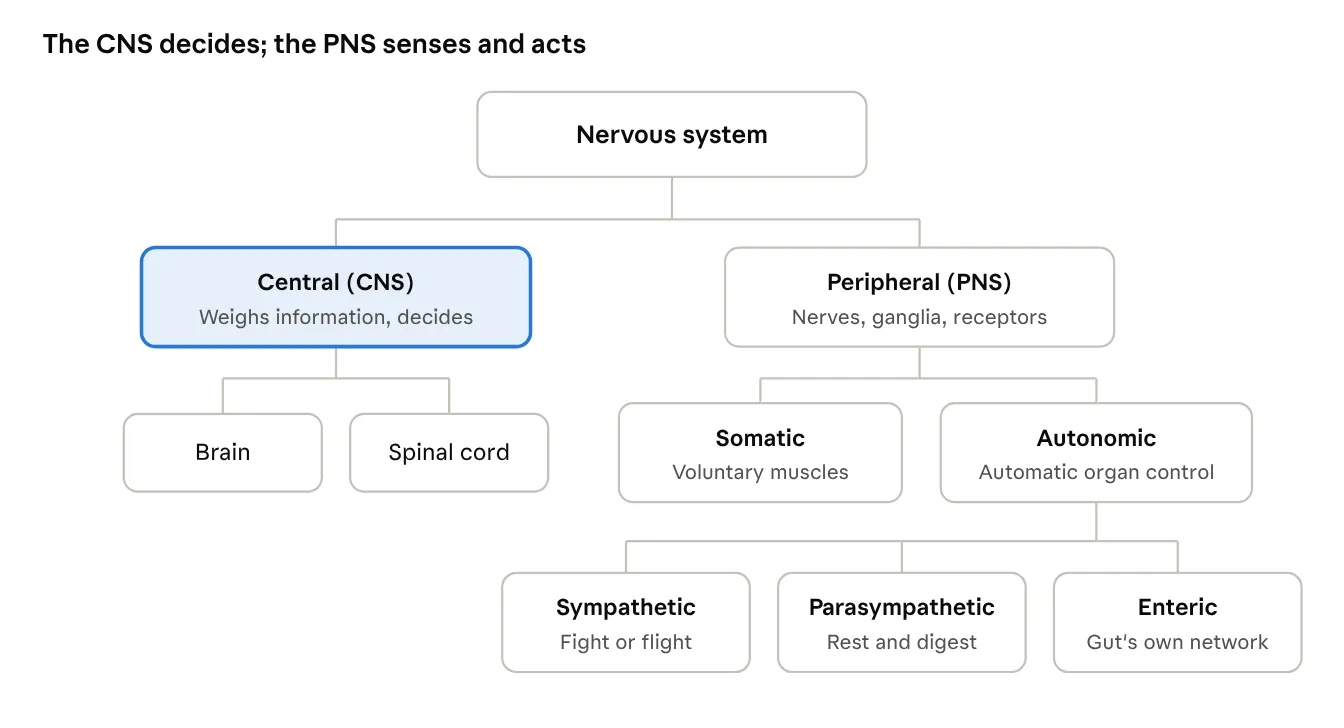
The nervous system is the brain, the spinal cord, the sense organs and every nerve that links them to the rest of the body. Together they let the body’s parts talk to each other and act as one.

It has two main parts:
- Central nervous system (CNS): the brain and spinal cord. This is the decision centre, where information is weighed and responses begin.
- Peripheral nervous system (PNS): everything outside the brain and cord. That means the cranial and spinal nerves, clusters of nerve cells called ganglia, and the sensory receptors spread through the body.
The PNS splits again. The somatic division runs the muscles you move on purpose, such as lifting an arm. The autonomic division runs what you never have to think about, such as heartbeat, digestion and sweating.
The three jobs: sense, decide, act
Everything the nervous system does fits into three steps that repeat all day long.
- Sense. Receptors in the skin, eyes, ears, muscles and organs track what is going on. Sensory (afferent) nerves carry those reports to the CNS.
- Decide. In the grey matter of the brain and spinal cord, networks of interneurons compare the reports, decide what matters, store some as memory and ignore the rest. This step is called integration.
- Act. Motor (efferent) nerves carry the decision out to an effector. That can be a skeletal muscle that moves you, smooth or heart muscle in an organ, or a gland that releases a hormone.
Picture touching a cold window. You feel the chill, your brain registers “cold”, and your hand pulls back or you reach for a shawl.
Neurons and glial cells: the building blocks
Nervous tissue is made of two kinds of cells. Neurons send messages, and glial cells keep the neurons alive and working.
Neurons
A neuron has three main parts:
- Cell body: the rounded centre that holds the nucleus and most of the cell’s machinery.
- Dendrites: short, branching arms that pick up signals from other neurons or from sensory receptors.
- Axon: one long fibre that carries the signal away to the next neuron, a muscle or a gland. Some axons run from the lower back all the way to the toes.

Arogya Yoga School
Teacher at Arogya Yoga School, Rishikesh — a Yoga Alliance registered school offering 200, 300 and 500 hour teacher trainings.


